How Long Does an Eviction Actually Take? A Timeline for Landlords
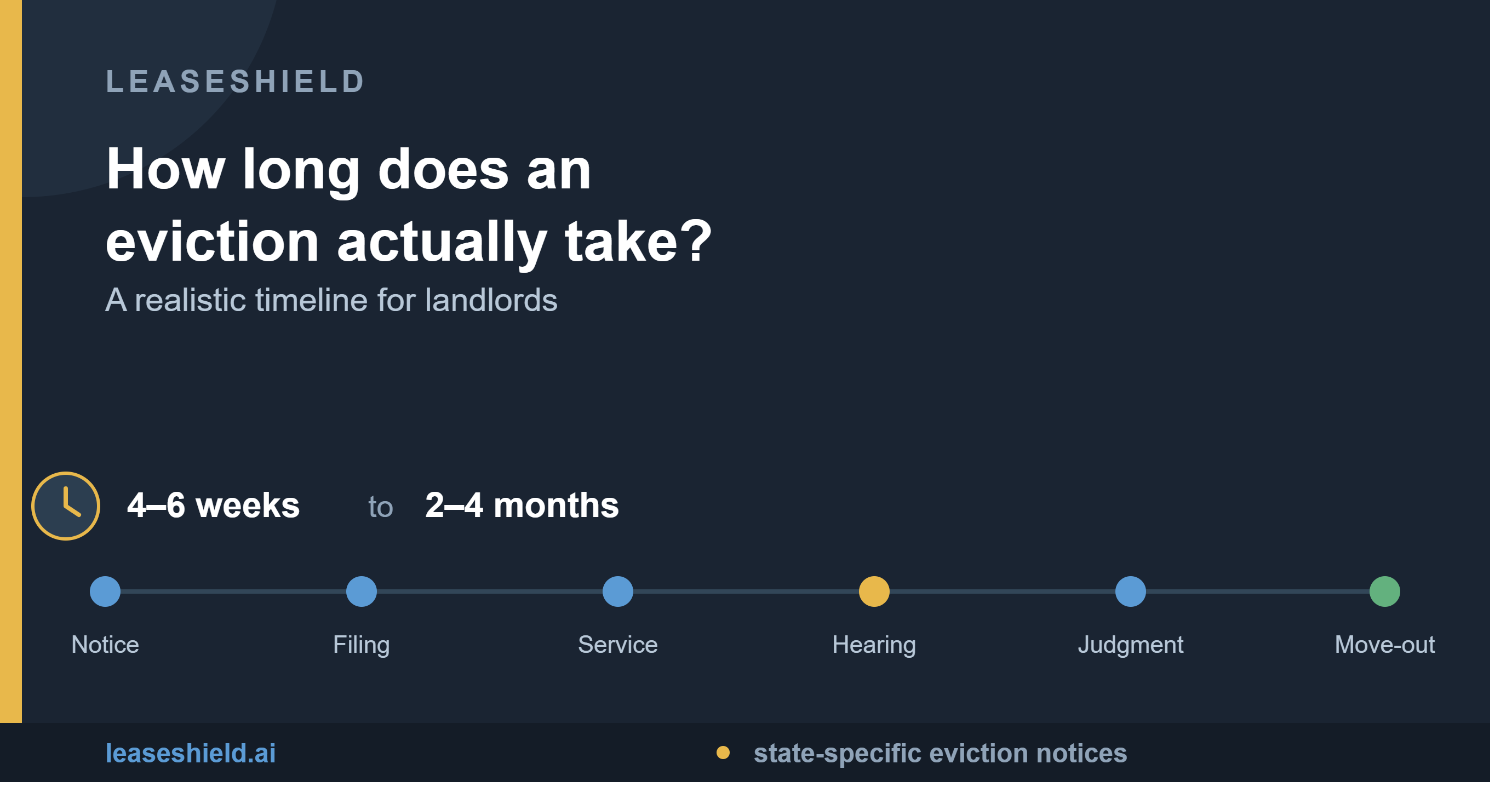
Sending an eviction notice is only the first step. Many landlords are surprised to learn that the entire process — from notice to actually regaining possession of the property — can take anywhere from a few weeks to several months, depending on the state, the court's schedule, and whether the tenant contests the case. Here's a realistic breakdown of each stage.
Stage 1: The Notice Period (3–30 Days)
Before you can file anything in court, the tenant must receive a notice and be given time to respond. This window is set by state law and depends on the reason for eviction:
- Nonpayment of rent: Typically the shortest window — 3 days in Florida, California, and Texas; 5 days in Illinois; 14 days in New York.
- Lease violations: Often similar or slightly longer, sometimes with a chance to "cure" the issue before the deadline.
- No-cause terminations (where allowed): Usually require 30 days or more, especially for month-to-month tenancies.
If the tenant pays, fixes the violation, or moves out during this window, the process ends here. If not, you can move to court.
Stage 2: Filing the Case (Same Day to 1 Week)
Once the notice period expires without resolution, you file an eviction case — often called an "unlawful detainer" or "summary process" action — with your local court. Filing itself is usually quick, but courts assign a hearing date based on their own schedule, which varies by jurisdiction and caseload.
What to expect: Busy urban courts can take longer to schedule a hearing than smaller jurisdictions. Some states have expedited eviction dockets; others do not.
Stage 3: Serving the Tenant with Court Papers (1–2 Weeks)
After filing, the tenant must be formally served with the court summons and complaint — separate from the original notice. This step has its own delivery rules and timelines, and courts are strict about proper service. If service isn't done correctly, the case can be delayed or dismissed.
Stage 4: The Court Hearing (2–8 Weeks After Filing)
This is usually the longest and least predictable stage. Hearing dates depend on court backlogs, and if the tenant contests the eviction, the case may be continued for further hearings or even go to trial.
What tends to speed this up: A well-documented case with a clean, correctly delivered notice, proof of amount owed, and clear violation of lease terms. What tends to slow it down: Missing paperwork, improperly served notices, or procedural challenges from the tenant's side.
Stage 5: Judgment and Writ of Possession (Days to a Few Weeks)
If the court rules in your favor, it issues a judgment for possession. In most states, this is followed by a writ of possession — a separate court order authorizing law enforcement to remove the tenant if they haven't left voluntarily. There's often a short additional waiting period built in here, sometimes 3–7 days, before the writ can be executed.
Stage 6: The Move-Out or Enforcement (Days to 1–2 Weeks)
Once the writ is issued, a sheriff or constable typically schedules the actual move-out. Landlords generally cannot remove a tenant or their belongings themselves — this step legally has to go through law enforcement in nearly every state.
Putting It All Together
For an uncontested nonpayment case with clean paperwork, landlords can sometimes reach possession in as little as 4–6 weeks from the original notice. For a contested case, or in a state with a slower court calendar, the full process can take 2–4 months or longer.
The biggest variable within a landlord's control is the first stage: making sure